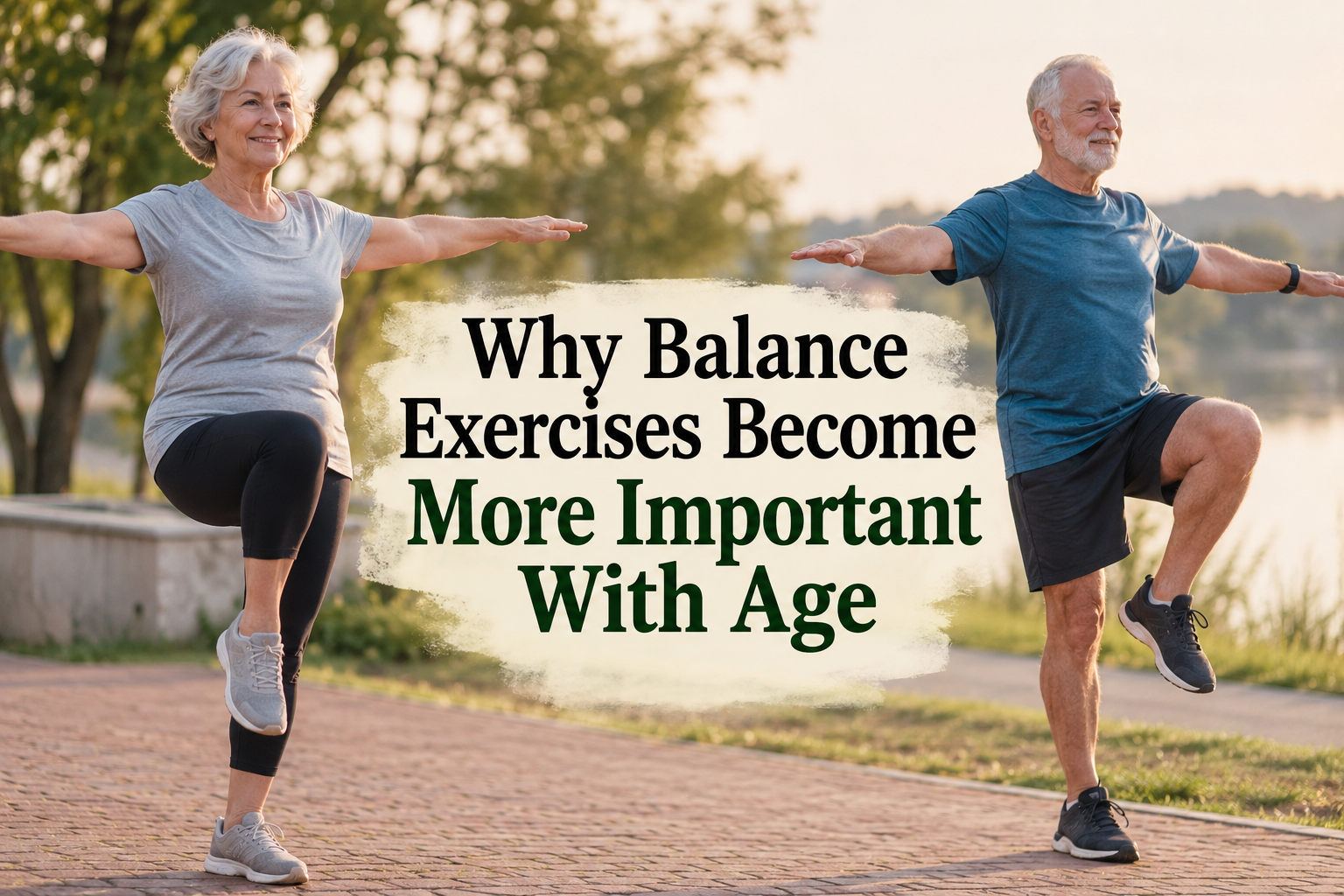
Balance is something most people rarely think about when they are young. Walking across a room, climbing stairs, getting out of a chair, or stepping over an object usually feels natural. The body makes hundreds of small adjustments without us even noticing. As we grow older, however, balance can slowly become less reliable. This is why balance exercises become more important with age.
Good balance is not only about standing on one leg. It depends on the muscles, joints, eyes, inner ear, nerves, and brain working together. When any of these systems become weaker or slower, staying steady can become more difficult. Regular balance exercises can help the body maintain coordination, confidence, and control during everyday activities.
Understanding why balance changes with age can help us appreciate the value of simple exercises that support stability and mobility.
What Balance Really Means
Balance is the body’s ability to stay stable while standing still or moving. It helps us control our position and prevents us from falling when the ground is uneven or when we suddenly change direction.
Several parts of the body work together to maintain balance. The eyes provide information about where we are in relation to our surroundings. The inner ear helps the brain understand movement and position. Muscles and joints provide information about how the body is moving. The brain receives all of this information and quickly makes adjustments.
When we are younger, these systems usually work quickly and efficiently. With age, some of them may gradually become less responsive. This can make balance exercises for older adults especially useful.
Why Balance Can Decline With Age
Aging affects almost every system involved in movement. Muscle strength may decrease if a person becomes less active. Joints may become stiffer. Reaction time may slow down, and eyesight can change.
The nervous system can also take slightly longer to process information. This means the body may not respond as quickly when balance is suddenly disturbed.
For example, if a person slips slightly on a wet floor, the body has only a short moment to react. Strong muscles, good coordination, and quick reflexes can help restore balance. If these abilities have weakened, the risk of falling may increase.
This is one reason why practicing balance regularly can become more valuable over time.
Balance Exercises Help Strengthen Important Muscles
Balance depends heavily on muscle strength, especially in the legs, hips, ankles, and core.
These muscles help support the body when standing and moving. If they are weak, maintaining a stable position becomes more difficult.
Simple movements such as standing up from a chair, walking, climbing stairs, and stepping onto a curb all require strength and control.
Balance exercises often activate several muscle groups at the same time. Standing on one leg, for example, requires the ankle, calf, thigh, hip, and abdominal muscles to make small adjustments.
Over time, practicing these movements can improve the body’s ability to stay steady during normal daily activities.
Better Balance Can Support Everyday Independence
One of the most important reasons to maintain good balance is independence.
Many daily activities require stable movement. These include getting dressed, taking a shower, reaching for objects, walking outdoors, carrying groceries, and moving around the home.
When people feel confident in their balance, they are more likely to stay active and complete these tasks without assistance.
Poor balance can have the opposite effect. A person who feels unsteady may avoid walking outside, using stairs, or participating in social activities. Over time, reduced activity can lead to weaker muscles and even less confidence.
Balance exercises can help break this cycle by supporting safer and more comfortable movement.
Balance Exercises May Help Reduce Fall Risk
Falls are a major concern as people grow older. A fall can sometimes lead to injury and a long period of reduced activity.
While no exercise can prevent every fall, regular balance training may help reduce some common risk factors. It can improve body control, muscle strength, coordination, and reaction speed.
When the body is trained to respond to small changes in position, it may be better prepared to correct itself when balance is disturbed.
For example, stepping sideways, reaching in different directions, or practicing controlled weight shifting can teach the body how to react more effectively.
Balance training is often most useful when combined with strength exercises and regular physical activity.
Balance Depends on Strong Legs
Leg strength plays a major role in stability.
The muscles in the thighs and hips help support the body while standing, walking, and changing direction. Calf muscles help control ankle movement and provide support during each step.
As people become less active, these muscles may gradually weaken. Long periods of sitting can also reduce the amount of movement the legs receive during the day.
Exercises such as chair stands, heel raises, gentle squats, and supported step movements can strengthen the legs while also improving balance.
Strong legs make it easier to recover from small slips or sudden movements.
Core Strength Supports Stability
The core includes the muscles around the abdomen, lower back, and pelvis. These muscles help keep the upper body stable while the arms and legs move.
A strong and active core supports posture and balance.
When the core is weak, the body may rely more heavily on other muscles for stability. This can make movements feel less controlled.
Balance exercises often activate the core naturally. For example, standing with the feet close together or slowly lifting one foot from the ground requires the abdominal and back muscles to work.
Regular practice can improve control without requiring complicated equipment.
Balance Exercises Improve Coordination
Coordination is the ability to control different parts of the body smoothly and efficiently.
Walking is a good example. The arms swing while the legs move forward, the feet adjust to the surface, and the eyes observe the environment. The brain coordinates all of these actions at once.
With age, coordination may become slightly slower, especially if physical activity decreases.
Balance exercises provide the brain and body with regular practice. Repeated movements help strengthen communication between the nervous system and muscles.
Activities such as walking along a straight line, stepping in different directions, or shifting body weight from side to side can improve movement control.
Reaction Time Is Important for Balance
Good balance is not only about staying still. It is also about responding quickly.
Imagine stepping on an uneven surface. The ankle may tilt slightly, and the body must immediately adjust. Muscles need to react quickly to prevent a fall.
Regular physical activity can help maintain this response.
Balance exercises that involve controlled movement can train the body to make faster adjustments. Even simple exercises can help improve awareness of body position.
This ability is particularly useful in real life because unexpected movements can happen at any time.
Balance Training Can Build Confidence
Confidence has a strong connection with physical movement.
People who are worried about falling may become cautious and avoid certain activities. Although this may seem safer, too much avoidance can reduce strength and mobility.
Regular balance practice can help a person become more comfortable with movement.
As stability improves, everyday tasks may begin to feel easier. This can encourage a more active lifestyle.
Confidence does not mean taking unnecessary risks. It means feeling more capable while moving safely and carefully.
Walking Is Helpful, but Balance Practice Adds More
Walking is one of the best forms of regular physical activity for many adults. It supports the heart, muscles, circulation, and overall fitness.
However, normal walking may not challenge balance in every direction.
Most walking involves moving forward. In daily life, the body also needs to move sideways, backward, turn, reach, and change direction.
Specific balance exercises provide practice for these movements.
For example, side stepping can improve control when moving laterally. Heel to toe walking challenges stability with a narrower base. Controlled reaching exercises train the body to stay steady while the upper body moves.
Adding these exercises to a normal walking routine can create a more complete approach to mobility.
Simple Balance Exercises Can Be Done at Home
Balance training does not always require a gym or special equipment.
Many exercises can be performed at home near a wall, sturdy chair, or countertop for support.
A basic exercise is standing with the feet close together for several seconds. Another is slowly lifting one foot while lightly holding a chair.
A person can also practice shifting weight from one leg to the other.
Heel raises are another simple option. While holding a stable surface, slowly rise onto the toes and then lower the heels.
These exercises should be performed in a safe area without loose rugs or objects that could cause tripping.
Consistency Matters More Than Difficulty
Balance improves through regular practice.
It is not necessary to begin with challenging exercises. In fact, starting with movements that are too difficult can be unsafe.
Simple exercises performed consistently can be very effective.
As balance improves, exercises can gradually become more challenging. A person might reduce the amount of hand support, stand with the feet closer together, or add slow movements.
Progress should happen gradually and comfortably.
A few minutes of balance practice several times a week can be easier to maintain than long and difficult sessions.
Posture Also Affects Balance
Posture influences how the body’s weight is distributed.
When standing upright, the head, shoulders, hips, knees, and feet work together to maintain alignment. Poor posture can shift the body’s center of gravity and make balance more difficult.
With age, some people develop habits such as leaning forward or looking down while walking.
Strengthening the back, core, and legs can help support better posture.
Balance exercises also encourage awareness of body position. This can make standing and walking feel more controlled.
Foot and Ankle Strength Matters
The feet and ankles are often overlooked when thinking about balance.
However, they are the body’s direct connection with the ground.
Small muscles in the feet help adjust to changes in surface. Ankle muscles respond when the body leans slightly in one direction.
Weak or stiff ankles can reduce stability.
Gentle ankle movements, heel raises, toe raises, and controlled standing exercises can help maintain strength and mobility in this area.
Comfortable and supportive footwear can also make walking safer.
Vision Plays a Role in Balance
The eyes provide important information about the environment.
They help us judge distance, recognize obstacles, and understand where the body is located in space.
Changes in vision can therefore affect balance.
Regular eye care becomes increasingly important with age. Good lighting inside the home can also make movement safer.
Balance training helps the body use information from different systems, but clear vision remains an important part of safe mobility.
Staying Active Supports Balance
A generally active lifestyle can help preserve many abilities needed for good balance.
Walking, gardening, light strength training, stretching, and other forms of movement help keep muscles active and joints mobile.
People who remain physically active often have more opportunities to practice coordination naturally.
In contrast, long periods of inactivity can lead to muscle weakness and reduced confidence.
This is why balance exercises work best as part of a broader active lifestyle rather than as the only form of exercise.
Safety Should Always Come First
Balance exercises should always be performed carefully.
Beginners should practice near a stable surface that can be held if needed. The area should be clear of obstacles, and the floor should not be slippery.
People who experience frequent dizziness, severe weakness, recent falls, or major mobility problems may need professional guidance before beginning new exercises.
A physical therapist or qualified healthcare professional can recommend exercises based on individual ability.
The goal of balance training is to improve safety, not create unnecessary risk.
Why Balance Exercises Become More Important With Age
The main reason balance exercises become more important with age is that the body’s natural systems for stability can gradually change.
Muscle strength may decrease, reaction time may slow, and coordination may become less precise. Vision, joints, and the nervous system may also change.
Regular balance training gives the body continued practice.
It can strengthen important muscles, improve coordination, support reaction time, and increase confidence during everyday movement.
Most importantly, good balance helps people continue doing normal activities with greater comfort and independence.
Final Thoughts
Balance is easy to ignore until it begins to feel less reliable. Yet it plays a role in almost every movement we make, from standing up in the morning to walking across a busy room.
As we grow older, maintaining balance becomes an important part of staying active and independent.
Simple balance exercises can support muscle strength, coordination, posture, and body awareness. They do not need to be complicated, but they should be practiced regularly and safely.
A few minutes of focused balance training can become a valuable part of a healthy routine. Combined with walking, strength training, good nutrition, and an active lifestyle, it can help support mobility and confidence for many years.